Showing posts with label Future of Work. Show all posts

Sunday, 18 September 2022

Work without Jobs by Ravin Jesuthasan and John W. Boudreau - Summary of some key arguments

Work without Jobs - How to reboot your organisation's work operating system by Ravin Jesuthasan and John W. Boudreau 

The central argument of Work without Jobs is that traditional 'jobs' should be 'deconstructed' into their underlying components, such as tasks and projects; with the complementary result that jobholders are seen in terms of their capabilities and skills.

This shift essentially would see the end to the 'job description'; and C.V.s would focus more on capabilities and skills, rather than experience in the form of educational milestones and previous job titles.

The approach 'requires fundamentally rethinking concepts like work, leadership, culture and organization' (p.ix)

"The new work operating system will require a profound change in the mindset and behaviour of leaders. It requires managers to think in terms of how tasks and projects are accomplished, not how jobs are organized." (p.100)

The authors employ the analogy of computer operating systems:

  • The old, traditional Operating System - categorises work into job and jobholders into worker through an employment relationship. It is characterised by job descriptions, job hierarchies and job qualifications.
  • The new Operating System - 'deconstructs jobs into their components and allows work to be perpetually reinvented by recombining those granular elements' (p.xi). It embraces a wider view of how work gets done embracing 'the gig economy' and 'alternative work arrangements' such as freelancers, contractors and volunteers (p.xii). 'The new world of work is one "beyond employment".' (p.xv)

Jesuthasan and Boudreau believe that this tradition OS 'is too cumbersome and ill-suited to the future.' (p.xi) and 'work systems (e.g planning, sourcing, choosing, assigning developing, engaging, rewarding) must evolve to reflect this new language of work'.

The authors propose that organisations break down their deparmental silos and develop internal platforms that allow talent to flow to work (such as projects) - effecting creating the opportunity for work to be done by anyone skilled to do it, be they brought in from outside the organisation (external gigs) or within the organisation ("inside gigs").

"The key is optimally and perpetually reinvent work by combining options such as the following: (p.xxx)

  1. Talent in fixed roles with regular full-time employees.
  2. Talent who flows to tasks and assignments - perhaps because their enabling capabilities are required in short-term specific burst by several different work processes (e.g. a freelancer or project-basd data scientist who moves between projects in marketing, HR and operations as needed.)
  3. Talent who are in hybrid roles that are partially fixed because of work volume or skills dedicated to a job, but who can flow to specific challenges as needed (such roles often emerge from internal talent marketplaces where regular jobholders take on additional project work).

Impact of Automation

Jesuthasan and Boudreau acknowledge that automation has a significant part to play in the future of work. Their approach is summarised by the following four principles:
  1. Start with the work (i.e. deconstructed current and future tasks) - not with existing jobs;
  2. Combine humans and automation (not replacing one with the other);
  3. Consider the full array of human work engagements (e.g. employment, gig, freelance, alliances, projects, other alternative work arrangements);
  4. Consider allowing talent to flow to work (this might be facilitated by an internal or external platform).
Tasks need to be evaluated according to the skill level that is required - basic repetitive tasks should be autotmated; "below license " tasks that cannot be automated should an unskilled, gig or trainee worker where possible; leaving highly skilled workers to focus on "top of license" tasks. (p.139)

Implications for education (pp.127-33)

Jesuthasan and Boudreau touch briefly on the implications for education, whilst acknowledging that a full discussion of the implications on education is beyond the scope of the book.  The new Work OS "means shifiting from a focus on worker education as degrees to focus on deconstructed learning and capabilities." (p.127)

The authors advocate a much more flexible approach to learning, arguing for "stackable credentials" ("part of a sequence of credentials that can be accumulated over time and move an individual along a careerpath or up a career ladder.") See 'More students are stacking credentials en route to a degree' Wired June 2, 2020.

Drawing on the work of Evelyn Glanzglass of the Center for Postsecondary and Economic Success, they highlight that the following challenges need to be overcome for this to happen (p.130-32):

  1. Create a common langue for workplace and educational credentials;
  2. Develop a common system of the transfer (portability) and value of credentials between institutions;
  3. Bridge silos between and within educational institutions;
  4. Overcome the disconnect between credit and noncredit course offerings;
  5. Provide financial aid for deconstructed credentials, not only degrees;
  6. Optimize and integrate the mix of learning in traditional classrooms, online, and experience.

Sunday, 2 February 2020

Daniel Susskind A World Without Work (2020) Summary of Key Arguments

Daniel Susskind, Economics don at Balliol Oxford, leads the reader through a persuasive well-structured argument that the automation that we are seeing today will be profoundly different from technological change in the past. The consequence of this is that we need to rethink the status of work and look to new ways to shape our society in a ‘world without work’.

The Context 

Ch.1. A History of Misplaced Anxiety 

A survey of the effect of technology on work over the past three centuries is characterised by two rival forces: a harmful substituting force which displaces human beings from performing particular tasks because the technology is faster or cheaper; and a helpful complementing force which raises demand for the work of humans to perform other tasks (e.g. the rollout of ATM machines did not replace bank tellers, but it meant that their role changed to provide customers with a better service p.26)
The helpful complementing force to date has done this in 3 ways:
  1. the Productivity Effect: machines have made displaced workers more productive at other activities; 
  2. the Bigger Pie Effect: technology has made economies and incomes around the world much bigger; 
  3. the Changing Pie Effect: technology changed how consumers spend their incomes and how producers make goods and services available.
“Up until now, in the battle between the harmful substituting force and helpful complementing force, the latter has won out and there has always been large enough demand for the work that human beings do” (p.28)

Ch.2. The Age of Labour 

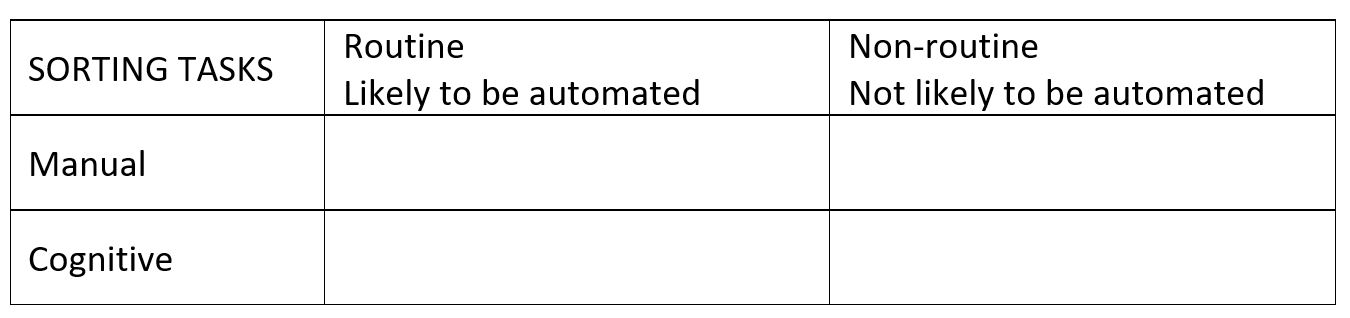
“a time when successive waves of technological progress have broadly benefited rather than harmed workers.” Autor-Levy-Murnane ALM Hypothesis: Machines could readily perform the ‘routine’ tasks in a job, but would struggle with the ‘non-routine’ ones (p.39) Technological progress is neither skill-biased or unskilled-biased it was task-biased (p.40).

Ch.3. The Pragmatist Revolution and Ch,4. Underestimating Machines

Greek Poet Archilochus: ‘The fox knows many things, but the hedgehog knows one big thing.’ p.64 – “we should be wary not of one omnipotent fox, but of an army of industrious hedgehogs” p.67)
AI Purists (cognitive scientists) closely observe human beings acting intelligently and try to build machines like them. This approach and the quest for Artificial General Intelligence AGI, to date, has failed. (c.f. the omnipotent fox remains illusive)
AI Pragmatists (computer scientists) take a task that requires intelligence when performed by a human being and build a machine to perform it in a fundamentally different way – relying on advances in processing power and data storage. The quest for Artificial Narrow Intelligence ANI is proving quite fruitful (c.f. the army of industrious hedgehogs).
“The temptation is to say that because machines cannot reason like us, they will never exercise judgement; because they cannot think like us they will never exercise creativity; because they cannot feel like us, they will never be empathic. All that may be right. But it fails to recognise that machines might be able to carry out tasks that require empathy, judgement or creativity when done by a human being – but doing them in some entirely different fashion.” (p.72-73)
“We do not need to solve the mysteries of how the brain and mind operate to build machines that can outperform human beings.” (p.74)

The Threat 

5. Task Encroachment 

Technology is encroaching on all areas of work: Manual capabilities (agriculture, driverless cars, car manufacturing, construction industry, 3D printing); Cognitive capabilities (Law, Medicine, Education, Finance, Insurance, Botany, Journalism, Military – “Computational creativity”) Affective Capabilities (“affective computing”, “social robotics”)
Task encroachment will be taken up at different paces. Because
  1. “some tasks are far harder to automate than others”; 
  2. in some industries the cost of human labour is low and complexity of automation is high (e.g. cleaning, hairdressing, table-waiting); 
  3. different cultures and jurisdictions will have different attitudes and regulations. 

Ch.6. Frictional Technical Unemployment 

“There is still work to be done by human beings; the problem is that not all workers are able to reach out and take it up” (p.99).
Three reasons for this:
  1. A Skills Mismatch (work available for much more qualified or more skilful); 
  2. An Identity Mismatch (work available but doesn’t fit will self-image – not a graduate job, or a man’s job – jobless lorry drivers may not want to do “pink collar” work such as child care); 
  3. A Place Mismatch (the work available may be in a different part of the country/ world) 
There will be 3 consequences of Frictional Unemployment: the “technological overcrowding, with people packing into a residual pool of whatever work remains within their reach” (p.109):
  1. there will be downward pressure on wages; 
  2. there will be downward pressure on the quality of the work; 
  3. there will be downward pressure on the status of the work available (rich-poor, master-servant divide). 

Ch.7. Structural Technical Unemployment 

In the future the Complementing Force is likely to be much weaker: 1) The Productivity Effect – “As task encroachment continues, human capabilities will be come irrelevant . . . for more and more tasks” (p.114); 2) The Bigger-Pie Effect – “a growing demand for good may mean not more demand for the work of human beings, but merely more demand for machines” (p.116); 3) The Changing Pie Effect – for consumers, “As task encroachment continues, it becomes more and more likely that changes in demand for goods will not turn out to be a boost in demand for the work of humans, but of machines” (p.119); and for producers, “As task encroachment continues, will it not become sensible to allocate more of the complex new tasks to machines instead?” (p.121).
“It is a mistake to think that there is likely to be enough demand for them [human beings] to keep everyone in work” (p.124). 
For Susskind, at present there is an assumption that human beings are superior to machines; in future we may need to assume that we are inferior.
“Just as today, we talk about ‘horsepower’ harking back to a time when the pulling power of a draft horse was a measure that mattered, future generations may come to use the term ‘manpower’ as a similar kind of throwback, a relic of a time when human beings considered themselves so economically important that they crowned themselves as the unit of measurement” (p.130). 

Ch. 8. Technology and Inequality 

 “The largest economic pies, belonging to the most prosperous nations, are being shared out less equally in the past” (p.137) 
The longstanding relationships between traditional (33.3%) and human capital (66.6%) is changing: Traditional Capital “is everything owned by the residents and governments of a given country at a given point of time, provided that it can be traded on some market” (p.133). Human Capital is “the entire bundle of skills and talents that people build up over their lives and put to use in their work” (p.134).
Susskind identifies three trends (p.146):
  1. “human capital is less evenly distributed”; 
  2. “human capital is becoming less and less valuable relatively to traditional capital”; 
  3. “traditional capital is distributed in an extraordinarily uneven fashion”. 
“Today many people lack traditional capital, but still earn an income from the work that they do, a return on their human capital. Technological unemployment threatens to dry up this latter stream of income as well, leaving them with nothing at all” (p.149). 

The Response 

Ch.9. Education and its Limits 

“’More education’ remains our best response at the moment to the threat of technological employment."
We can do this in 3 ways:
  1. What we teach: “do not prepare people for tasks that we know that machines can already do better; or activities that we can reasonably predict will be done better by machines very soon” (p.158) N.B. “Many tasks that cannot yet be automated are found not in the best-paid roles, but in jobs like social workers, paramedics and schoolteachers.” 
  2. How we teach: non traditional blended-learning and online learning methods need to become more commonplace. 
  3. When we teach: we need to move to a world of life-long learning: “People will have to grow comfortable with moving in and out of education, repeatedly, throughout their lives. We will have to constantly re-educate ourselves” (p.160). 
BUT
“Even the best existing education systems cannot provide the literacy, numeracy and problem-solving skills that are required to help the majority of workers compete with today’s machines” (p.165). 
“Some people may cease to be of economic value: unable to put their human capital to productive use, and unable to re-educate themselves to gain other useful skills” (p.166). 
“Education will also struggle to solve the problem of structural technological unemployment. If there is not enough demand for the work that people are training to do, a world-class education will be of little help” (p.166). 

Ch. 10. The Big State 

The role for the state in the C21 world without work is to deal with the looming disparities and inequalities in society. It will do this through taxation and redistribution of income and wealth. Taxation: 
  1. 1) taxing workers who have managed to escape the harmful effects of task encroachment; 
  2. 2) taxing capital – taxing “the income that flows to owners of increasingly valuable traditional capital” (p.176); 
  3. taxing big business – this needs to be tackled at a global level. 

Redistribution: Susskind rejects the idea of Universal Basic Income (UBI) which has no strings attached. He has an excellent critique of the problems associated with membership criteria for UBI. He argues instead for a Conditional Basic Income (CBI) which requires recipients to contribute in some way (to be defined) to society. This is based on a view of ‘contributive justice’ whereby everyone feels that their fellow citizens are giving back to society. His vision is for a ‘Capital-sharing State’ and a ‘Labour-supporting State’.

Ch. 11. Big Tech 

For Susskind, Big Tech companies are here to stay for two reasons:

  1. Expensive Resources: it costs enormous amount to develop new technologies – huge amounts of data, world-leading software, and extraordinarily powerful hardware. Small firms cannot compete and talented ones just get bought out. 
  2. Network effects – networks are more rewarding the bigger they get. 
Susskind rejects the economic arguments against large monopolistic firms – most are not abusing their monopoly economically. Instead he questions their political and social influence. Here he argues for new regulatory institutions which can insist on greater transparency and ensure that liberty, democracy and social justice are not under threat.

Ch,12. Meaning and Purpose 

A world without work throws up philosophical questions about how human beings find meaning; and practical questions of how people will spend their leisure time: volunteering, unpaid work, community required activities (see Conditional Basic Income above).
 “A job is not simply a source of income but of meaning, purpose and direction in life as well” (p.215). 
In the C21 “Work is the opium of the People”. Work has meaning beyond the purely economic. “The problem is not simply how to live, but how to live well” (p.236).
Revisiting Education. Spartan King Agesilaus: ‘the purpose of education is to teach children the skills that they will use when they grow up.’ Perhaps schools should prepare young people for a world of leisure: character, virtue, life skills education.
“If free time does become a bigger part of our lives, then it is likely also to become a bigger part of the State’s role as well” (p.234) 
A world without work throws up three fundamental problems:
  1. the problem of inequality; 
  2. the problem of political power; 
  3. the problem of meaning.

This is an important book - essential reading for anyone who is interested in preparing young people for the future.

Thursday, 1 August 2019

Invisible Women - by Caroline Criado-Perez - Book Summary

Some books change society - Invisible Women by Caroline Criado-Perez sets out to be one of those. It is a book that every legislator, every employer, indeed, everyone who believes in a truly equal society should read.
The core argument is simple:  
  • There is a significant gender data gap because most of the data which we collect is not sex-disaggregated.
  • This matters because 'data determines how resources are allocated' (p.256)
  • This means that 'Male is the default Human' with a consequence that
  • The world is designed by men for men and this is not working (and, at times, dangerous) for women.
  • Furthermore, 'Gender neutral does not automatically mean gender equal' (p.309)
Criado-Perez demonstrates this thesis by looking in turn at range of issues which illustrate that women have different priorities and needs:

Daily Life

  • 'Women's travel patterns tend to be more complicated' than men's because they do more unpaid care work (p.30).
  • Women have different needs re toileting (this is a safety issue both in terms of hygiene and attacks from men). This strikes a chord with anyone who has witnessed the queues for women's toilets

Workplace

'Women's work, paid and unpaid, is the backbone of our society and our economy' (p.142).
  •  'Women do the majority of unpaid work irrespective of the proportion of household income they bring in' (p.71) - 'Globally, 75% of unpaid work is done by women'. This has implications of women's health and financial status. There is a need for properly paid maternity leave.
  • 'Women continue to be disadvantaged by a working culture that is based on the ideological belief that male needs are universal' (p.86). 
  • There is a significant gender pay gap, which needs addressing - collecting and analysing data on hiring procedures to see whether these are gender neutral is a good place to start (p.110).
  • There are a range of occupational health issues which affect women differently to men (Chapter 5)
  • There are significant issues with sexual harassment at work (estimated 50% of women in the EU p.137) which need addressing.
  • 'The culture of paid work as a whole needs a radical overhaul. It needs to take into account that women are not the unencumbered workers the traditional workplace has been designed to suit' (p.91).

Design


There is a 'one-size-fits-men approach to supposedly gender-neutral products [which] is disadvantaging women' (p.157).
  • The problem is not women, it is with male-based design. 
  • Examples: Grand Piano keyboard width (p.157), Smartphones (p.159), Voice-recognition software (p.162 - if it doesn't work for a woman - try lowering your voice!); online datasets (p.164).
  • Women find it difficult to get funding for design ideas. One factor is that '93% of VCs are men and men back men' (p.171).  'Given the male domination of VCs, data gaps are particularly problematic when it comes to tech aimed at women' (p.174).
  • 'The [male-dominated] tech industry is rife with examples of tech that forgot about women' (p.176).
  • 'Car design has a long and ignominious history of ignoring women' (p.185). 'When a women is involved in a car crash she is 47% more likely to be seriously injured than a man, and 71% more likely to be moderately injured . . . She is also 17% more likely to die' (p.186).

Medicine

We have 'a medical system which, from root to tip, is systematically  discriminating against women, leaving them chronically misunderstood, mistreated and misdiagnosed' (p.196)
  • There are significant sex differences (pp.198ff):
    • fundamental mechanical workings of the heart
    • lung capacity
    • women are 3x more likely to develop an autoimmune disease
    • blood-markers for autism - etc
  • 'Because women have largely been excluded from medical research, this data is severely lacking' (p.199) ... 'The failure to include women in medical trials is a historical problem that has its roots in seeing the male body as the default human body' (p.201).
  • 'The lack of sex-disaggregated data affects our ability to give women sound medical advice' (p.208).
  • There are many drugs and treatments that don't work for women.
  • Yentyl Syndrome: 'women are misdiagnosed and poorly treated unless their symptoms or diseases conform to that of men' (p.217).
  • There is a lack of research into medical issues that mainly or only affect women (p.229)
'Women are dying, and the medical world is complicit. It needs to wake up.' (p.216)

Public Life

'The failure to measure unpaid household services is perhaps the greatest gender gap of all.' (p.241)
  • Unpaid work is excluded from definitions of Gross Domestic Product (GDP). 'The omission of housewives from national income computation distorts the picture' (Paul Studenski, p.241).
  • 'The upshot of the failure to capture all this data is that women's unpaid work seems to be seen as a costless resource to exploit' (Sue Himmelweit, p.244)
  • Taxation: 'There's a fairly simple reason why so many tax systems discriminate against women, and that is that we don't systematically collect data on how tax systems affect them' (p.260)
'Together with our woman-blind approach to GDP and public spending, global tax systems are not simply failing to alleviate gendered poverty: they are driving it.' (p.264)
  • 'The presence of women in politics makes a tangible difference to the laws that get passed' (p.266).
  • Discussion of women in politics - and a call for electoral reform.
  • 'The evidence is clear: politics as it is practised today is not a female-friendly environment' (p.281).
  • 'When you exclude half the population from a role in governing itself, you create a gender gap a the very top' (p.285)
  • 'Female politicians are not operating on a level playing field' (p.286)

Disaster Situations

  • 'The failure to include women in post-disaster efforts can end up in farce.' (p.290). This is illustrated with examples from Gujurat in 2001; Miami 1992 Hurricane Andrew; New Orleans 2005 Hurricane Katrina
  • 'The presence of women at the negotiating table not only makes it more likely that an agreement will be reached, it also makes it more likely that the peace will last' (p.294).
  • 'Women are disproportionately affected by conflict, pandemic and natural disaster ... Domestic violence against women increases when conflict breaks out' (p.296).
  • 'The data gap when it comes to sexual abuse is compounded in crisis settings by powerful men who blur the lines between aid and sexual assault' (p.306)
  • Homelessness: 'women are actually more likely to experience homelessness than men' (p.306)

Afterword

  • Criado-Perez identifies three important themes that define women's relationship with the world:
  1. The female body: this needs to be taken into account in design medical, technological and architectural.
  2. Male sexual violence against women: we need to measure it and design out world to account for it - not to do so is to limit women's liberty.
  3. Unpaid care work: we need to measure this and to make it more equitable.
'Failing to collect data on women and their lives means that we continue to naturalise sex and gender discrimination.' (p.314)
One major reason why gender data gap needs to be addressed as a matter of priority is because 
'the introduction of Big Data into a world full of gender data gaps can magnify and accelerate already-existing discriminations.' (p.136)
The Book

This is a very well researched book. It is fully referenced and indexed allowing the reader easily to follow up on the points made.