Showing posts with label History. Show all posts

Saturday, 26 October 2013

Seven Days in May by Knebel and Bailey - Book Review

Seven Days in May is a thriller that was published in the U.S. in September 1962. Then it was a work of contemporary fiction working through a scenario in which a group of senior military chiefs plot to remove the President because of his decision to sign a controversial nuclear arms pact with the Soviet Union. Seven Days in May is a good read for two reasons. 
First, it's an enjoyable fast-moving page turner in the Flemming tradition: can a small band of Presidential loyalists thwart the efforts of the U.S. military might hell-bent on sedition? (No spoilers here).
Secondly, and much more interestingly, was the impact year the novel had when it was published. Although the authors place the events of Seven Days in May in (the future) 1973, there is little doubt that the novel was a commentary on the precariousness of the situation in which JFK found himself in 1961-2. Indeed, JFK's military chiefs had expressed concerns about his handling of the Bay of Pigs (April 1961) and the Cold War was heading for the Cuban Missile (October 1962). According to Thurston Clarke, 
Knebel got the idea [for the novel] from an interview with Air Force Chief of Staff Curtis LeMay shortly after the Bay of Pigs. LeMay was still furious with Kennedy for refusing to provide air support for the Cuban rebels, and after going off the record accused him of cowardice. Knebel also found inspiration in a 1962 conversation with Secretary of the Navy John Connally. With LeMay's remarks fresh in his mind, Knebel had turned the conversation to the military's unhappiness with the president. Connally acknowledged that some of his admirals disliked taking orders from teh New Frontiersman, and felt that they could express themselves politically. Later in the Conversation Connally mused that the atomic bomb had created the conditions in which "the U.S. might unwittingly be laying the groundwork for a military dictatorship."    (JFK's last Hundred Days, 2013 p.95)
Kennedy read Seven Days in May when it was published and it struck a chord. His private conversations at the time indicated that he himself had considered the possibility of a military coup and, on one occasion, even went so far as to name some generals at the Pentagon who he thought "might hanker to duplicate fiction" (Bergquist and Tretick A Very Special President, 1965, p.15). It is likely to have played on his mind all the more when, in 1963, he, like President Lyman in the novel, embarked on negotiations with the Russian Premier (over  the Nuclear Test Ban Treaty) and then had to battle to persuade both Congress and the military of its good sense.
Kennedy was enthusiastic about plans to make the novel into a movie and even went away on a long weekend to allow for the shooting of crowd scenes around the White House. He thought that it would serve "as a warning to the Republic" and hoped it would "raise the consciousness about the problems involved if the generals got out of control" (Schlesinger Robert Kennedy and His Times, 1978, p.450). The movie of Seven Days in May, starring Burt Lancaster, Kirk Douglas and Ava Gardner was released in February 1964.
Seven Days in May is an easy entertaining read, but it also has importance in the impact that it had in shaping ideas in wider U.S. society about the relationship between the Presidency, the military and the Constitution.

Sunday, 20 October 2013

JFK's Last Hundred Days: An Intimate Portrait of a Great President by Thurston Clarke - Book Review

JFK's Last Hundred Days tracks Kennedy's diary commitments for the last three months in the the run up to the tragic events of 22nd November, and in so doing it provides a snap-shot into what it is to life the life a US President. On one level the picture given is one familiar to any executive or leader: a man moving from meeting to meeting, giving speeches and making decisions on half a dozen key projects. It just happened that the 'key projects' on which JFK was having to make decisions were some of the greatest domestic and political issues in the post-war era, namely Black civil rights, the Cold War, Vietnam and Cuba. One day he was attempting to navigate the passage of a civil rights bill that would give blacks a more equal place in US society; the next he was negotiating a Nuclear Test Ban Treaty with the Soviets. Vietnam posed challenges on a daily basis, as Kennedy had to decide whether or not to support a coup against Minh.
What comes through is a man who gave great leadership to his Administration. According to Clarke, Kennedy's drive and higher purpose came from a deep sense of wanting to be judged one of the greatest, if not the greatest, US President by "the high court of history". His last hundred days was a period where Kennedy played the cards he had at his disposal to work towards winning the Cold War to secure a safer world for the nation's children. His approach was informed by his experiences as a in the Navy in World War II; and, more recently, by the events of the Cuban Missile Crisis where he knew better than most how close the world came to nuclear holocaust.  This was most clearly seen in his dealings with the Soviets, where he was prepared to face criticism for signing the Test Ban Treaty and because of the agreement to sell (surplus) grain to the USSR. In so doing he made the first steps towards mutual trust and peace. Likewise, in the last weeks before his assassination he came to the realisation that the time was fast approaching to withdraw the US 'advisers' from Vietnam. At the same time, he was pursuing a two-track strategy on Cuba, supporting rebel groups whilst trying to open up channels of communication with Castro. Both Khrushchev and Castro recognised that these were to some extent personal initiatives that, to a greater or lesser extent, died with him. 
Kennedy certainly did not have everything his own way. He was forced to temper his moral instincts with realpolitik in order to have any hope of carrying rival political factions and thus pass bills through Congress. He also had to keep one eye on the upcoming 1964 Presidential election. An example of this was his approach to the Civil Rights bill where he need to balance the demands of Martin Luther king and others campaigning for black rights, without alienating too many voters in the South on whom he would be relying.
Much has been written of JFK's colourful personal life and his infidelities have been well documented. However Thurston Clark presents us with a different picture during this period. The recent death of their son, Patrick, cast a signficant shadow over JFK and Jackie's last hundred days together and there were signs that their relationship was on a much firmer footing. Ironically this was a key factor in Jackie making the trip to Dallas.
Reading this book is rather like watching the film Titanic - we all know the ending and the reader inevitably latches onto every clue that points to the inevitable outcome along the way: the repeated warnings from friends and advisers about the inadvisability of going to the "hornet's nest" that was Dallas, concerns from his secret service minders about JFK's unthinking desire to make himself available to the people, and even the proleptic dinner party conversations about how he would like to die. 
Thurston Clarke is to be congratulated on his "intimate portrait of a great President".

Monday, 19 August 2013

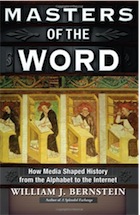
Masters of the Word by William J Bernstein - Book Review

Masters of the Word - How Media Shaped History from the Alphabet to the Internet. 
In Masters of the Word William Bernstein takes the reader on a journey through human history exploring the relationship between innovations in media and the shifts in political power. His thesis is that the ruling classes have exercised influence over the masses through control of access to the media, and that the democratisation of the media is a key factor in giving the masses a greater say in how they are ruled. 
In the ancient world through to the late Middle Ages, literacy gave power and the educated elite jealously guarded the influence that it brought. The very ability to be able to record transactions paved the way to a legal system that could resolve disputes peacefully - a legal system that ensured that power remained with the literate few. Most importantly, literacy allowed rulers to exert influence over greater distances. Hence the invention of writing and later the alphabet enabled the Summerians to establish the first empire and the relatively high levels of literacy in the Roman Army to rule from Britain to the Middle East. The importance of a literate educated elite in Christianity and Islam ensured the influence of religion. Indeed the Church of Rome retained its power through operating in Latin rather than the vernacular - thus establishing an international language for itself whilst putting up a barrier between it and most of the population. Bernstein is creative in the way in which he takes episodes from history to illustrate the part that new media have played in changing the relationship between rulers and the ruled. 
Printing Press. Gutenberg's printing press combined with greater vernacular literacy allowed Luther to challenge the power of Rome, where others (Huss and Wycliffe) has failed. The rise of Fleet Street in Britain and the one-penny presses increasingly held rulers to account, whereas in Germany, Nazi party control of many of the German newspapers helped them to power. 
Radio. Roosevelt's command and skill on the Radio enabled him to win three terms as President; in the hands of Goebbels it was the political weapon that brought together a nation behind Hitler; and in Rwanda, it was the means of orchestrating a genocide. The radio in the form of "the Voices" (the BBC, Radio Liberty, Voice of America and Deutsche Welle) also played an instrumental role in bringing together opposition groups behind the Iron Curtain. 
Copiers. One of the strongest parts of the book is where Bernstein documents the lengths to which dissidents in Soviet bloc countries, such as Alexander Solzhenitsyn, used to disseminate their ideas: 'samizdat' (using typing and carbon copying) and 'magnitizat' (using tape recordings). Despite control of the mass media by the Soviet authorities and with the help of "The Voices" these dissidents galvanised opposition that eventually led to the end of communism. 
Internet. Bernstein documents the way in which the Internet has brought about a significant shift in power, so that rulers in Western democracies are accountable more than ever before to the ruled (Wikileaks, MPs expenses scandal etc.). The Internet (in the form of Twitter and Facebook) has also played (and continues to play) a significant part in bringing about democratic change in Tunisia and Egypt (Arab Spring). Bernstein is reticent about concluding that the Internet age will bring about world-wide democratic change, arguing (after Lopez Rodo) that, although a contributory factor, it is less significant than increases in prosperity. 
There is an interesting technical strand to this book where Bernstein seems to enjoy engaging with the science behind each technological development. He explores in detail the Summerian development of alphabet, the particular typesetting issues that Gutenberg overcame, how radio signals work and were exploited by Hertz and Marconi, and the development of photocopiers.
Masters of the Word is one of those really interesting history books that explores a theme through the Ages, thus giving the reader a novel and interesting perspective on otherwise familiar ground by making new connections.  This is seen most clearly as Bernstein traces comparisons between reactions from traditionalists to the introduction of new media, whether that be the scribe Filippo de Strata predicting that the octavos of Ovid cranked out by the "brothel of the printing presses" would make young women wanton, or the criticism of the Internet and amateur bloggers by professional journalists:
"The criticisms you are hearing are the age-old howls of communications elite facing the imminent loss of status and income."  (p.323)
One note of caution, if archaeology and the history of language are not your thing then the first section of the book might be a bit dry - do persevere (or skip to the next chapter) - it is worth it. The book, like the media it is discussing, gains momentum as it heads through history.  Overall, a very enjoyable summer read. 

Monday, 22 July 2013

Kandak - Patrick Hennessy - Book Review

Kandak by Patrick Hennessey is an eloquent account of the role that the Afghan forces are playing in battle against the Taliban. It is a considered counterblast to the many official and unofficial Regimental accounts of the conflict which focus on the undoubted exploits of the British forces, whilst glossing over the heroic contribution of the Afghans. In so doing, Hennessey challenges the British Army orthodoxy which caricatures which the Afghan forces as ill-disciplined, untrustworthy and even cowardly.
Hennessey, now a barrister, in putting together his case for the defence, draws strongly on his own experience as a Grenadier Guard Captain embedded as a mentor to an Afghan 'Kandak' (Fighting unit) in Sangin and Helmand in 2007 and interviews conducted in the field on two subsequent visits.
The book falls into two parts; The first is the account of his growing friendship and camaraderie with Afghan soldiers, forged by fighting alongside them in the heat of Op Silicon and the push into the Green Zone. For Hennessey, there was no "them and us" - indeed, he clearly felt a closer bond with the members of his Afghan Kandak than he did with members of other British regiments serving out there at the time. Hennessey's views are not rose-tinted - there is a balanced realism to his apologetic. The result is a passionate account of brave Afghan soldiers who, despite a different approach and some failings, have lost lives and limbs in this attritional conflict in which there really are no winners. 
The second part of the book is more reflective, as Hennessey draws on other military authors and press coverage as he grapples with the wider question of the nature, history and lessons learned from the Afghan conflict and the role that the Afghan forces are playing. Hennessey explores with great insight the relationship between the Afghans and their British mentors, a relationship characterised by mistrust on both sides. 
One of the strongest and well-written parts of the book is the chapter 'Sex, Drugs and Shades of Grey' (p.252) where Hennessey explores the cultural and moral differences between the British and Afghan forces. It is here that he goes onto the offensive. Perhaps freed up by some distance from the Regiment, he points out the hypocrisy of 'functioning alcoholic [British] officers' banned for drink driving criticising Afghans for taking drugs; or indeed the body-building Paras, and 'pink lacy thong'-wearing Marines calling Afghans 'bender boys'.
Hennessey summarises his intent in his epilogue:
"I wanted to provide a glimpse of men like Qiam, Syed Hazrat, Mujib and the others because they weren't the inept jokers we had thought we would work with in 2007, neither are they Western puppets, neither are they a lost cause or the complete solution. They are what we all were: ordinary solideris doing a difficult, sometimes extraordinary, job. Whatever anyone else thinks . . . the warriors of the ANA, wounded, tired, downbeat though they sometimes were, never doubted that what they were doing was worth the cost." p.366
This book is beautifully written (as befits a Berkhamsted scholar who read English at Oxford) with some wonderful human observation (try the chapter on 'Military Tourism' p.283ff ).
Kandak is a sequel to Patrick Hennessey's first best-seller, The Junior Officer's Reading Club (My Review). 


Saturday, 16 April 2011

Niall Ferguson: Challenging how we teach History

The highlight of this year's ISC Annual Conference was having the opportunity to listen to Niall Ferguson outlining his concerns about the way in which schools are forced to teach History in this country. I have recently started reading his [so far] excellent book, Civilization: The West and The Rest, in which he comments on the problem,
"In schools, too, the grand narrative of Western ascent has fallen out of fashion. Thanks to an educationalists' fad that elevated 'historical skills' above knowledge in the name of 'New History' - combined with the unintended consequences of the curriculum-reform process - too many British children leave school knowing only unconnected fragments of Western history: Henry VIII and Hitler, with a small dose of Martin Luther King, Jr."
Introduction p.18
He develops these ideas further in the Preface to the UK edition,
"Watching my three children grow up, I had the uneasy feeling that they were learning less history than I had learned at their age, not because they had bad teachers but because they had bad history books and even worse examinations.

"For more than thirty years, young people at Western schools and universities have been given the idea of a liberal education, without the substance of historical knowledge. They have been taught isolated 'modules', not narratives, much less chronologies. They have been trained in the formulaic analysis of document excerpts, not in the key skill of reading widely and fast. They have been encouraged to feel empathy with imagined Roman centurions or Holocaust victims, not to write essays about why and how their predicaments arose.

"In The History Boys, the playwright Alan Bennett posed a 'trilemma': should history be taught as a mode of contrarian argumentation, a communion with past Truth and Beauty, or just 'one fucking thing after another'? He was evidently unaware that today's sixth-formers are offered none of the above - at best, they get a handful of 'fucking things' in no particular order."
Preface xix
I am sure that Niall Ferguson's observations ring true with many history teachers, who feel boxed in by examination specifications and bemoan the loss of the opportunity for real historical study, particularly at A-level.

No one wants to see a return to History solely being about the rote learning of historical dates and of the names of the kings and queens of England, but I have been concerned for many years that young people lack a simple historical framework on which to hook ideas. Without such a framework it is not possible for young people to make connections between events and to develop understanding and insight. It is reassuring that such an eminent and well-known historian as Niall Ferguson is taking up the cause.

Friday, 13 March 2009

History isn't bunk

Letter to the Editor

Sir,

The restatement of the importance of teaching history in schools [editorial 12/03/09] is welcome not only for the excellent reasons outlined by Mr Gove, but also because it hones some of the most important life skills needed in the digital age. History teaches us to evaluate the quality of source material, to handle rival views, and to evaluate arguments. In a world when many young people take the first entry in Google as gospel, these are essential skills if they are to learn to sift the wheat from the chaff when researching on the internet.

Mark S. Steed
Principal
Berkhamsted School
Herts.