Showing posts with label Internet. Show all posts

Monday, 19 August 2013

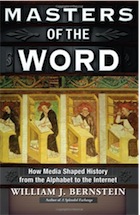
Masters of the Word by William J Bernstein - Book Review

Masters of the Word - How Media Shaped History from the Alphabet to the Internet. 
In Masters of the Word William Bernstein takes the reader on a journey through human history exploring the relationship between innovations in media and the shifts in political power. His thesis is that the ruling classes have exercised influence over the masses through control of access to the media, and that the democratisation of the media is a key factor in giving the masses a greater say in how they are ruled. 
In the ancient world through to the late Middle Ages, literacy gave power and the educated elite jealously guarded the influence that it brought. The very ability to be able to record transactions paved the way to a legal system that could resolve disputes peacefully - a legal system that ensured that power remained with the literate few. Most importantly, literacy allowed rulers to exert influence over greater distances. Hence the invention of writing and later the alphabet enabled the Summerians to establish the first empire and the relatively high levels of literacy in the Roman Army to rule from Britain to the Middle East. The importance of a literate educated elite in Christianity and Islam ensured the influence of religion. Indeed the Church of Rome retained its power through operating in Latin rather than the vernacular - thus establishing an international language for itself whilst putting up a barrier between it and most of the population. Bernstein is creative in the way in which he takes episodes from history to illustrate the part that new media have played in changing the relationship between rulers and the ruled. 
Printing Press. Gutenberg's printing press combined with greater vernacular literacy allowed Luther to challenge the power of Rome, where others (Huss and Wycliffe) has failed. The rise of Fleet Street in Britain and the one-penny presses increasingly held rulers to account, whereas in Germany, Nazi party control of many of the German newspapers helped them to power. 
Radio. Roosevelt's command and skill on the Radio enabled him to win three terms as President; in the hands of Goebbels it was the political weapon that brought together a nation behind Hitler; and in Rwanda, it was the means of orchestrating a genocide. The radio in the form of "the Voices" (the BBC, Radio Liberty, Voice of America and Deutsche Welle) also played an instrumental role in bringing together opposition groups behind the Iron Curtain. 
Copiers. One of the strongest parts of the book is where Bernstein documents the lengths to which dissidents in Soviet bloc countries, such as Alexander Solzhenitsyn, used to disseminate their ideas: 'samizdat' (using typing and carbon copying) and 'magnitizat' (using tape recordings). Despite control of the mass media by the Soviet authorities and with the help of "The Voices" these dissidents galvanised opposition that eventually led to the end of communism. 
Internet. Bernstein documents the way in which the Internet has brought about a significant shift in power, so that rulers in Western democracies are accountable more than ever before to the ruled (Wikileaks, MPs expenses scandal etc.). The Internet (in the form of Twitter and Facebook) has also played (and continues to play) a significant part in bringing about democratic change in Tunisia and Egypt (Arab Spring). Bernstein is reticent about concluding that the Internet age will bring about world-wide democratic change, arguing (after Lopez Rodo) that, although a contributory factor, it is less significant than increases in prosperity. 
There is an interesting technical strand to this book where Bernstein seems to enjoy engaging with the science behind each technological development. He explores in detail the Summerian development of alphabet, the particular typesetting issues that Gutenberg overcame, how radio signals work and were exploited by Hertz and Marconi, and the development of photocopiers.
Masters of the Word is one of those really interesting history books that explores a theme through the Ages, thus giving the reader a novel and interesting perspective on otherwise familiar ground by making new connections.  This is seen most clearly as Bernstein traces comparisons between reactions from traditionalists to the introduction of new media, whether that be the scribe Filippo de Strata predicting that the octavos of Ovid cranked out by the "brothel of the printing presses" would make young women wanton, or the criticism of the Internet and amateur bloggers by professional journalists:
"The criticisms you are hearing are the age-old howls of communications elite facing the imminent loss of status and income."  (p.323)
One note of caution, if archaeology and the history of language are not your thing then the first section of the book might be a bit dry - do persevere (or skip to the next chapter) - it is worth it. The book, like the media it is discussing, gains momentum as it heads through history.  Overall, a very enjoyable summer read. 

Wednesday, 9 January 2013

Do I have a Right to be Forgotten?

An excellent Radio Four programme on the ethics and legalities of gaining control of our digital presence.


"When Emma Barnett, a tech-savvy 27 year old typed her name into a search engine she found photos from her past she would really rather forget. And she is not alone; millions of people are sharing photos, tweets and status updates with friends every day - later discovering, regretfully, that they live online forever.
But with the European Union hoping to enshrine a "right to be forgotten" will it become possible to own your online life? On this journey Emma discovers what rights she has to delete material from the internet and the implications this has on how we record events and write history."

Thursday, 8 December 2011

Wednesday, 7 December 2011

"All change please - the Internet is coming"

Extract from the opening address at the Independent Schools Council ICT Strategy Conference 07/12/11

"At first glance we have taken a rather retro title for today's conference and I am sure that many will consider the title ironic. For all but the one or two colleagues for whom the Internet still poses more of a threat than an opportunity, there’s nothing new about the Internet. We have all enjoyed its increasing benefits over the past twenty years and it has changed how our classrooms look and feel. Digital projectors and Interactive White Boards have been ubiquitous for over a decade and the arrival of reliable classroom connectivity this has meant that teachers have been able to harness the many resources that we find on the Internet, be that seismic sites in Geography or YouTube clips of science experiments and World War footage elsewhere in the curriculum. However, if you go into most of our classrooms today, you will still find teachers at the front of the class, very much still in control, and (in most cases at least) only using the Interactive Whiteboard as an expensive mouse. Good Internet access in schools has not changed fundamentally how we have been teaching. If Teachers have long been the high priests of subject knowledge and are loathe to give it up their status.


The Internet may not have had a significant impact on how we teach, but I do believe that it is going to transform how pupils learn. However, in a very real sense we do need to prepare for change for, indeed, the Internet is coming! We meet today at a significant time of change for the way in which we do learning in our schools. It has only been relatively recently that two factors have come together that will change the way we do education. First, broadband Internet has gone mobile. Increasingly we can take it for granted that we can access the Internet anywhere, not just when we're plugged in, but also on the move. We are now used to being permanently connected and what's more at a relatively cheap cost - well unless you leave Data Roaming on when you go abroad - that's when it really comes home how cheap it is on a daily basis! Secondly, we now all have access to a range of web-based applications that make it possible for users around the world to collaborate on projects, without the constraints of having to run the same software package.

Reliable access to broadband Internet on mobile devices combined with the rise of high quality easily accessible, web-based collaborative tools has the potential to transform learning. These two factors are empowering pupils, allowing them to have a greater say and take greater control over how they learn. Young people are beginning to study differently and we are beginning to see a shift that is taking control away from teachers and giving it to the pupils.

Several years ago I was privileged to hear Dylan Wiliam address the HMC Conference on Teaching and Learning. The essence of his argument was that pupils learn more from each other than from the teacher. What he said struck a chord with me. I was teaching classroom ICT at the time [teaching the ECDL to Year 9] and could see this dynamic in action. Two or three pupils in the class got what I said, and I could literally see this knowledge spread around the classroom virally as pupils taught each other how to navigate the inner workings of the MS Office suite. Indeed, when I look back on my time at school, it was my friend with whom I caught the train to and from school who taught me Maths; and I taught him R.S. As far as we were allowed, we asked others in the class to explain the things that we didn’t get first time. I didn’t realize it then, but fundamentally we were teaching each other.


We now have web-based tools in place that allow pupils to share ideas and to collaborate on projects. Google Docs and a whole range of web-based freeware enable pupils to comment on each other's work, to pool their collective knowledge and understanding. Pupils are able to share their expertise with other pupils, they are able to refine their ideas and to bring on the weaker students.

Collaborative working is one of the most important skills that this generation of pupils is going to need in life - it is already the norm in work place. It is perhaps a digital immigrant’ s perspective to even ask the question, but this way of working raises a whole range of issues about what constitutes cheating. Collaboration is the norm and it certainly is the future.

The whole Wikipedia project is based on the premise of the "Wisdom of the Crowd", i.e. that there are sufficient experts and enthusiasts 'out there' who collectively know more any individual and who will correct, update and amend articles. Using collaborative tools allows teachers to harness the "Wisdom of the Class" - allowing pupils to share ideas and to support each other.

I am a great believer that classrooms should be "places of learning" rather than "places of teaching". Schooling is not about well-crafted lessons, but about whether or not pupils actually learn. Such an approach demands that the role of teachers will change. Yes, there will be a key role for teachers in the new order, but it will be different to their traditional role. Teachers will need to be facilitators, setting up the structures for the collaboration to take place. They will need to set the assignments and they will need to monitor that the discussions are on track, but a light touch approach is what will be required. Pupils operate best when they see this as "their" space. Teachers are able to follow the discussions and even to join in the discussions when necessary.

So I do believe that we, once again, we find that ICT is the engine of educational revolution. New technologies will mean that schools will begin to operate differently. So, in a very real sense, once again we must say, "All change please - the Internet is coming".