
Lichtenstein: A Retrospective at Tate Modern is the first comprehensive account of his art since his death in 1997 and sets out to reassess "Lichtenstein's enduring legacy". The inevitable consequence is an exhibition that is, like Lichtenstein's career itself, hit and miss.
Lichtenstein is at his best when he is parodying some aspect of society, whether that be the cliched portrayal of women in the press and advertisements, or the glorification of war in comic books, or, indeed, other artists. The rooms that explore these aspects are the undoubted highlights of the exhibition.
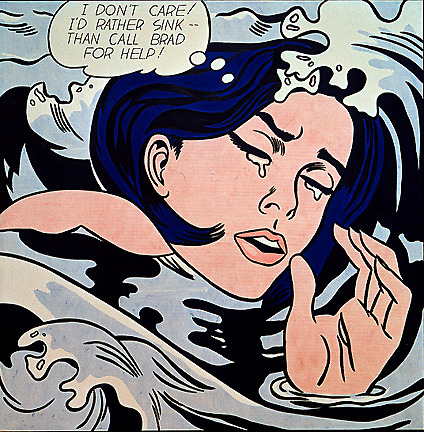 |
| Lichtenstein, Drowning Girl, 1963 |
Lichtenstein's iconic Ben-Day dot Pop Art paintings are stunning and the room which focuses on 'War and Romance' brings together a number of the comic-book canvasses, which made him famous. The strength of many of these works is Lichtenstein's interest in the 'pregnant moment' which leave the viewer hanging and having to fill in the details of the missing surrounding narrative:
"Oh Jeff, I love you too, but ..." (Oh Jeff, 1964) "I don't care! I'd rather sink than call Brad for help!" (Drowning Girl, 1963)
"That's the way it should have begun! But it's hopeless!" (Hopeless, 1963)
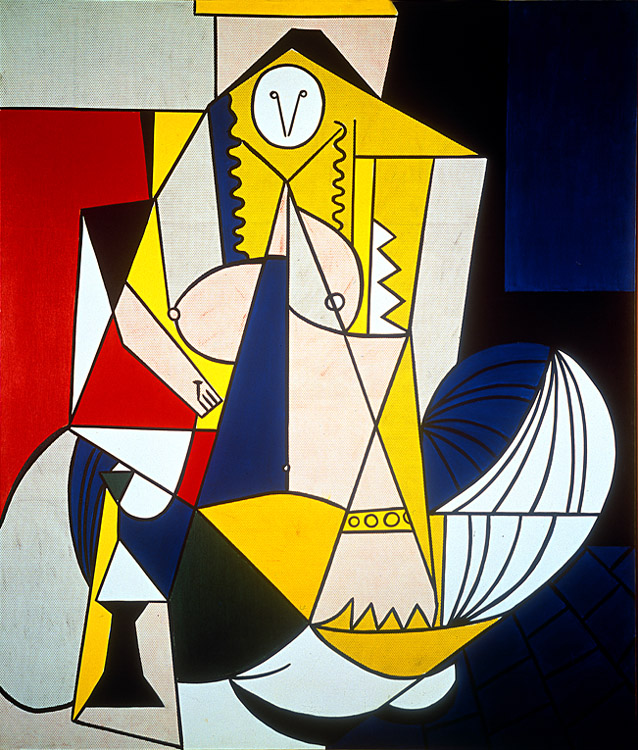 |
| Lichtenstein Femme d'Alger, 1963 |
Likewise, the room 'Art about Art' explores the ways in which Lichtenstein translated key works by other artists whom he admired, such as his Femme d'Alger 1963, which reworks Picasso's Woman of Algiers, 1955 in Bed-Day style.
However, this exhibition also explores the lows of Lichtenstein's career. The gallery guide dutifully introduces: "The Perfect/Imperfect series is a relatively unknown group of works, which explore the vocabulary of abstraction with geometric fields that challenge the edges of traditional canvasses." These are a "relatively unknown group of works" for a reason - they are very poor. Nowhere are the lows seen more clearly than in the Room 'From Alpha to Omega: Early Abstractions and Late Brushstrokes' which juxtaposes some of Lichtenstein's works from 1959-60 with some of his later ones from 1996. I applaud the curators on the inclusion of these "little-known" works in the Retrospective as gives us a complete picture which allows us to reassess "Lichtenstein's enduring legacy". In short, his work was quite poor when he deviated from his Ben-Day dot parody winning-formula, which interestingly he did return to with considerable success with a series of nudes from the mid-1990s.
This is a very enjoyable exhibition and I would encourage you to visit. It is very child/ teenager friendly. One advantage of the Lichtenstein's work is that it is large in format and relatively easy to process. Thus, although the gallery was packed, there were not the bottle-necks around the key works than one associates with block-buster exhibitions (think Degas at the Royal Academy).
Lichtenstein: A Retrospective runs at Tate Modern until 27th May.


