Showing posts with label Working Smart. Show all posts

Wednesday, 10 July 2019

The Checklist Manifesto - How to get things right by Atul Gawande - Book Summary

This book has a very simple message:
  • The world of the professions has become increasingly complex to the point where no one professional (be they a surgeon, a pilot, an engineer, or an investment manager) can retain sufficient working knowledge to know it all. 
  • Human memory is fallible. 
  • People can lull themselves into skipping steps even when they remember them. 
  • Checklists seem to provide protection against such failures. 
Checklists “provide a kind of cognitive net” which “catch mental flaws inherent in us all.” (p.48) 
Gawande, a general surgeon, works out this thesis with extensive illustrative anecdotes. Gawande himself played an instrumental role in the development of the World Health Organisation Safe Surgery Checklist, which has established some basic norms around the world and has reduced the incidence of infection, complications and death during surgery. 

Drawing on the construction industry, he argues that the days of the Master Builder are long gone and that today skyscrapers are built by teams of professionals who work from daily work schedules (checklists) and who solve complex, unforeseen problems by effective communication and collective decision-making that is coordinated again through checklists. One of the key lessons that comes out of this is “When resolving complex problems, power needs to be pushed out of the centre as far as possible.” (p.75)

The origins of the checklist dates to WWII and pilots coping with the increasing complexity of planes. The aviation industry has been at the forefront of the implementation of checklists to ensure that established protocols are followed and to enable flight crews to manage the full range of possible disaster scenarios. They have identified two types of Checklist (p.123): 
  1. DO-CONFIRM checklists: where team members perform their tasks from memory and experience; and then PAUSE to confirm that they have done all that they are meant to have done. A complex procedure might have a number of “pause points”. 
  2. READ-DO checklists: people carry out the tasks as they check them off – like a recipe. 
Checklists = Discipline 
In conclusion, “Checklists improve outcomes with no increase in skill.” (p.168)

Saturday, 9 April 2016

Sleeping with your SmartPhone by Leslie Perlow - Book Review

This book is not about managing SmartPhone usage; it is about the steps that an organisation can take to improve the efficiency of how teams work, one by-product of which was that employees achieved a better work-life balance.
On one level it is the heart-warming story of how it took a Harvard Business School professor to get a group of highly paid workaholic consultants (Boston Consulting Group BCG) to turn their undoubted organisational talents inwards to achieve the simple goal of having one 'predictable night off' a week.
In essence there were two components to the 'Predictable Time Off' (PTO) project:
  1. A collective goal of Predictable Time Off
  2. Space for Structured Dialogue
Interestingly, the primary value of the PTO project was not that the employees ended up with more quality free-time (although in most cases that did happen), rather that the process itself set up a dialogue within the teams that in time fostered a mindset that challenged the status quo - challenging long-established ways of doing things and exploring new ones. The PTO process was a vehicle to change the culture of the organisation by opening up new methods of communication within project teams. PTO was an indirect way "to get people to challenge their beliefs about what the work requires as well as to cause people to actually make changes to how they do their work." (p.129).
Reflecting on the four years of the project, the author writes,
"What we have done at BCG is break the cycle of responsiveness and create a new system where all the components are now congruent around a new culture focused on getting the work done in ways that minimise the bad intensity and maximize individual's control." p.203
As one BCG partner summed it up,
"The value of PTO is in fighting that assumption that work-life balance and effective case teams are mutually exclusive. Because they are not." p.205
The obvious problem with this research project is that it is based around an acknowledged extreme of organisational behaviour where working away from home four nights a week is their form of norm, so people working in gentler contexts will have to translate accordingly.

This is an interesting and necessary piece of research. However, the book is in the overly repetitive style characteristic of many American business books, taking a simple message and story and milking it for all it's worth to the point that it justifies publication as a book, rather than as a pamphlet or magazine article.
Rather than buying the book I recommend that you read Leslie Perlow and Jessica Porter's  article, 'Making Time Off Predictable—and Required' Harvard Business Review (October, 2009); and Leslie Perlow's excellent TED talk, Thriving in an overconnected world

Monday, 4 April 2016

Bill Walsh Lessons in Leadership Part Two: An example of what not to do

Whilst The Score Takes Care of Itself has some excellent insights for leaders, the Bill Walsh story is also a cautionary tale, for it highlights the pitfalls of "Hero Leadership".


Pitfall No.1:  Inability to Delegate
Bill Walsh had an excellent knowledge of his industry, he had served his apprenticeship with some of the best and had had opportunity to develop his leadership style as Head Coach at Stanford. He was a perfectionist and this was his fatal flaw. As Head Coach and General Manager he took overall control of the whole organisation both on and off the field. He knew everyone's job, he had defined everyone's job, he set the standards for everyone's job, and believed that he could do everyone's job better than them (which may have been true) but ultimately it led to him 'burning out'.
"Somehow in my mind I believed that I as the best qualified to do almost every job, especially when it came to the offensive part of our game, In one sense, it stemmed from confidence; I was absolutely sure that if I did the job it would not get screwed up. Well that can only take you so far. Pretty soon you're on overload while very talented people in the organization are being underultilized. 
There were others, too, on my staff who are able and willing to take on more responsibilities. They were willing; I was reluctant, even unwilling - unable is perhaps more accurate.
Well that kind of thinking can only take you so far. Eventually you are working seven days a week, sixteen hours a day, with little good sleep, eating poorly, and dealing with all kind of forces."  (p.212-3)
Leaders need to look after themselves and one of the ways they can do this is by putting trust in the talented team that they have around them.. They need to use the capacity gained to take time away from the nitty gritty of work. to be able to reflect and to develop time on the ball (see blogpost).

Pitfall No.2: Perfectionism - knowing when to let things go
Bill Walsh strove for perfection - he loved what he calls the "puzzle of perfection". His analysis of the team's performance in when they beat Miami 38-16 to win their second Super Bowl (XIX) is a case in point (p.190-92): Walsh describes this as a "the closest I've ever come to coaching a perfect game", yet Walsh continues "two events marred it for me to this very day" and proceeds to deliver a detailed post-mortem on the two imperfect plays of the game.
Here lies the paradox that makes great leaders: leaders necessarily focus on things that go wrong because these are the areas for improvement; but the leaders who are able to sustain high levels of leadership need to learn when to let things go. Bill Walsh didn't and he allowed his perfectionism and attention detail to shift from being a creative to a destructive force.

Pitfall No.3:  Allowing Winning to become "Not-failing" - The Challenge of Sustained Success
No one expected the San Francisco 49ers to win Super Bowl XVI, a year after they had had one of the worst records in the league. However, with success came raised expectations and this only increased further when the 49ers won Super Bowl XIX four years later. Fear of failure drove Walsh to the point where victory was not enough - it simply became a form of not-losing. Walsh's advice with the benefit of hindsight was:
Avoid the destructive temptation to define yourself as a person by the won-lost record, the "score," however you define it. Don't equate your "won-lost record" with your self-worth. (p.225-6)
Walsh cautions against a world where executives cannot celebrate success because they are immediately preparing to win the next battle.

Pitfall No.4: Not Managing Up" - Not managing Expectations
Part of Walsh's problem in his latter years is that he did not "manage up" well. He allowed the owner of the club to have unrealistic expectations and set unrealistic, and ultimately unachievable, targets (a Super Bowl every year).  This was a major contributory factor to his burn out and early retirement.

The section where Walsh talks about the relationship with his owner (p.220-21) chimed with me. Throughout my 14 years of school leadership in the UK the most debilitating part of the job was managing expectations of Governors. In particular, there was always a constituency on the Board who, within minutes of my announcing record results for the nth consecutive year, shifted from momentary praise to laying out their expectations for even better results the following year. 
Over the years, I have realized that an important part of the role of a leader is to manage the expectations of key stakeholders (particularly, parents and Governors), Most of all, I have come to understand that I have a responsibility both to the staff, to the senior team, to the organisation and to myself to protect ourselves from short-term demands from Governors. Burnt out school leaders and staff do not bring about sustained school improvement - School Board members around the world and the British Government take note.

Monday, 27 July 2015

Changing the email culture of an organisation

There is little doubting that smart phones were the "game-changer" when it comes to email - once your work emails were on the phone there was no getting away from them . . . or indeed from work. For those of us who are technically minded achieving a work-life balance took on a new dimension.
Work emails coming through 'out of hours' have an ability to pull you instantly away from your family, friends and relaxation, back to the office. The arrival of a work email in your inbox can ruin an evening or weekend. They put the ball back in your court - they demand action, whether that be thought, a phone call, or (just!) the time to reply. One of the biggest problems with emails is that they are like a virus, they spawn more emails - they demand replies and very soon everyone is sending emails to each other. The consequence is that the whole tempo of the organisation speeds up to the point where it is out of control and people simply cannot cope any more.
The 1900 to 0700 Curfew 
Berkhamsted School is like most other organisations: emails came through morning, noon and night. We took the view in September 2013, that we would limit our internal email traffic to weekdays between 0700 and 1900 only. This principle was extended to parents in March 2015 - parents were informed that any emails sent outside 'office hours' would be dealt with the next working day. There is nothing to stop colleagues from drafting replies outside these times, so long as they use the 'delayed delivery' function in Outlook (Options - Delay Delivery). 
The key principle here is that we all to manage our own time as we see fit, but that it is wrong to put the ball into a colleague's court by sending an email outside the working day.
The Results
Two years on, the volume of email traffic has reduced and emails are generally more considered - there are fewer late night alcohol induced rants. Most importantly there has been a shift in mindset: there has been a cultural shift in the moral 'high ground' colleagues no longer feel guilty not replying to an email - colleagues now feel guilty for sending them. Colleagues now feel that it is acceptable to ignore evening and weekend emails. When colleagues break the curfew, it is quite common for them to preface their emails with "I'm sorry to break the curfew, but . . . ", which can be quite endearing when the 'but' is an enthusiastic member of the coaching staff sharing the weekend success of a school sports team.
The result is that the school is calmer. We are working smarter not longer. The whole exercise has meant that staff feel valued. Achieving a term-time work-life balance in our school community remains a challenge, but we have taken one small step in the right direction, and that is appreciated by us all.
Issues yet to be resolved - School Vacations
There are still a number of issues that need to be resolved as to how the school email protocol operates during the School holidays. We have to face the fact that teachers and school leaders get more annual leave than people who have made different career choices. We also have to acknowledge that a proportion of the time when schools are on vacation are times when teachers and school leaders work - to some extent it is "non-contact time" -  be that lesson preparation or performing management tasks. In the twenty-first century it is unreasonable for employees to be totally uncontactable for the six (or in the case of many independent schools - eight) weeks of the summer vacation - particularly for middle and senior leaders..  Here the general principles of the term-time protocol apply: emails are sent during the weekdays 0900 and 1700 and allowance is given when replies aren't the next day.
Teaching is a profession where clock-watching is not part of the professional mindset.
A key area of debate at Berkhamsted is the extent to which teachers should be available to examination year pupils during the key revision periods of Easter and the Summer half-term. There are arguments either way - this is a period when motivated pupils who are working their way through past papers can benefit enormously from teacher feedback, but it is also the time of year when teachers are under the greatest pressure. A balance needs to be struck; and in most cases, teachers are giving of their time and expertise when the pupils have made a consistent effort throughout the year and have managed their time well.

Key Lessons learned
  • A change in email culture needs to be driven from the top - school leaders need to be role models and create a culture where teachers 'have permission' to ignore 'out of hours' email traffic. It is well known that employees follow the lead of senior figures in organisations in order to get on: as School Principal, I made a point of activating my 'out of office' notification at weekends.
  • Breaches of the curfew need to be followed up with an informal conversation - particularly when the perpetrators are in the SLT.
  • Staff need training in how to use the 'Delayed Delivery' feature in Outlook.
Note on Independent and Maintained Sector Schools
This week, the Secretary of State for Education, Nicky Morgan, called for schools to ban 'out of hours' emails to ease the workload on teachers in the maintained sector ('Morgan: Ban emails after 5pm to help teachers cope with workload' Daily Telegraph 26/07/2015). I'm sure that this is a step in the right direction. There are different pressures in the two sectors: independent schools increasingly demanding fee-paying parents; and there is much more 'red tape' and bureaucracy in the maintained sector. Both create email and pressure.  Schools need space to do their jobs and limiting email traffic is one way to help teachers do this.

Berkhamsted School was award the Investors in People Gold Award in July 2015.

This article was written for publication in Schools Week.  See the article here.

Saturday, 25 January 2014

Steps for achieving a Work-Life Balance. Changing the 24/7 Email Culture - Part Two: The Results


On Monday 7th October I gave a presentation at a staff meeting suggesting that one small way in which we could achieve a greater work-life balance would be to reduce the number of emails that we send to colleagues in the evenings and at weekends.

The fundamental rationale behind this is that in many cases when we send an email to a colleagues we are 'putting the ball into their court' and place tacit pressure on them to reply. Now that many of us now have emails coming through to our phones and other mobile devices it is increasingly difficult to ignore work emails that come out of hours (see previous blogpost).

The Idea - No internal 'Out of Hours' Emails: At that staff meeting we agreed that, unless it is an emergency, we would endeavour not to send internal email at weekends or between 1900 and 0700 on weekdays.

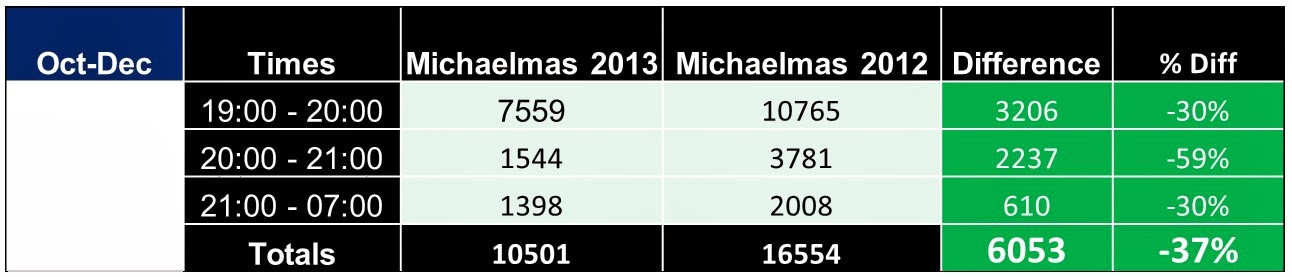
The Results: The three month trial is now over and the results are really quite impressive: we have reduced our total email traffic by 37% over the same period in 2012. These figures are for all email traffic, both internal and external, so it is likely that our internal traffic has reduced by an even greater amount..
We have reduced our evening and weekend email traffic by 37%
The greatest impact has been in a change of culture: fewer 'out-of-hours' emails are being sent, there is a greater use of the 'delayed delivery' function (so a hand-full of emails come through at 0700), indeed, I suspect that fewer internal emails are being sent during the day. It is clear that the balance has tipped - the 'moral high ground' is with the person who has received an 'out of hours' email, rather than with the colleague who is working at the weekend and sent it. This empowers colleagues to feel that it is acceptable to ignore evening and weekend emails.   
The result is that the school is calmer. We are working smarter not longer. The whole exercise has meant that staff feel valued.
Achieving a term-time work-life balance in our school community remains a challenge, but we have taken one small step in the right direction, and that is appreciated by us all.

Many thanks to Dave Pacey, Berkhamsted School's Director of ICT, for producing these statistics.

Afternote (12/04/2014):
'When the French clock off at 6pm, they really mean it'  Guardian 09/04/2014

Sunday, 22 September 2013

Steps for achieving a Work-Life Balance. Changing the 24/7 Email Culture - Part One: The Idea

I'm sure that every organisation is the same, but I think that we are in danger of email overload. Senior leaders, middle managers, teachers and some support staff are sending emails to each other at all times of the day (and night), both on weekdays and throughout weekends. The prevalence of smart phones now means that we have access to work emails even when we are away from our desks. There is no place to hide - work can track us down wherever we are. This 24/7 email culture is not healthy, it is not conducive to effective downtime and personal/family life, and it is not efficient: we are in danger of working longer, but achieving less.
Schools are very intensive places. We have two modes of existence: holiday and term. We have the great privilege of having more holiday than most, but all that means is that in term-time we work both long and hard. Work inevitably spills over into evenings and weekends. 
Whilst some colleagues prefer to answer emails in the evenings and at weekends, it is all too easy for a culture to develop where it is acceptable to enter into an email correspondence at all hours.
Sending an email may reduce the size of my inbox, but, in so doing, it increases the size of someone else's.
As in tennis, my reply puts the ball into someone else's court. There is little doubt that receiving an email in the evening or at weekends puts tacit pressure on colleagues to reply. There is also a danger that colleagues within the organisation believe that the only way to get on is to be available 24/7, which certainly is not the case.
So here are some ideas that we are considering that we hope will change the culture:

Limit internal email traffic to specific hours
We are considering making it a rule of the organisation that it is only acceptable to send a work email to a colleague between 0700 and 1900 on weekdays. The only exception would be an emergency maintenance/IT/caretaker request.
This proposal does not prevent colleagues working outside these times. Indeed, if a colleague wishes to draft replies to emails “out of hours” that is fine. Such should be saved as Draft (using the “Save” function) or sent with delayed delivery (select “Delay Delivery” from the “Options” tab in Outlook). This may mean that we come into work (especially on Mondays) to be greeted by lots of emails, but at least we will have had a weekend/evening off.

Encourage staff to turn off their mobile
We want to encourage staff to take quality personal/ family time.  We need to change the culture so that colleagues feel comfortable making themselves uncontactable "out of hours". Ideas include:
  • Turn off your phone/ Turn your phone to Airplane mode – that way you won’t receive Email traffic. 
  • Set your phone to go to automatic “Do not Disturb” On an iPhone this is: Settings – Notifications – Do Not Disturb – Scheduled – Set Times (e.g. 2100 – 0700).  It is possible to “Allow Calls from Favourites” and there is a setting to allow “Repeated Calls” 
  •  Use the "Out of Office" feature in Outlook more often.
Think Differently
  • We shouldn’t feel guilty for taking time away from work. 
  • We shouldn’t feel that we always need to be contactable. 
  • We should ask ourselves, “Can it wait?” and “Do I need to disturb a colleague’s evening?” 
And so . . . 
We're still at the discussion stage, but opening up the debate has reduced the amount of evening and weekend traffic to a trickle.  I'm endeavouring to lead by example and haven't sent an out-of-hours email for a fortnight.  Initial impressions are that life is becoming calmer. I'll let you know how it goes . . . .

See also