Showing posts with label Malcolm Gladwell. Show all posts

Sunday, 11 July 2021

The Bomber Mafia - Malcom Gladwell: Brief Summary

The Bomber Mafia is a book about two approaches to a problem. The problem in question was 'What is the best way to end WWII by bombing?' The context was the last year of the war and the target was Japan.

Malcolm Gladwell narrates the story of two US Air Force Generals: Brigadier General Haywood Hansell and Major General Curtis LeMay both of whom, at different times, were in command of the Twenty-First Bomber Command stationed on a cluster of small islands, the Marianas, in the middle of the Western Pacific (Guam, Saipan and Tinian). The significance of these islands was that they were (just) in range for a B29 bomber to run a raid to Tokyo and other significant Japanese industrial cities.

The first General, Hansell, was a devotee of the 'The Bomber Mafia', a group within the Air Force command who believed that air power alone could win a war. They believed that the precision bombing of key strategic pinchpoints could bring the enemy to his knees (and thus to surrender). without committing thousands of troops on the ground. In the 1930s this concept was quite and ran contrary to the prevailing US military thinking which, given that it had been the case in nearly every war to date, saw ground troops as essential to military success. Furthermore, they believed that, unlike blitz bombing, precision bombing would also minimise non-combatant casualties - thus there was a moral dimension to this view. At the heart of Hansell and the Bomber Mafia's belief was that they placed enormous faith in the 'Norden Bombsight' which, they claimed could enable an airborne bombardier to drop a bomb into a pickle barrel from six miles up. Sadly this faith was misplaced and Hansell's B29 bombers never managed to effect high level precision bombing of key Japanese instillations.

For this reason he was replaced by General Curtis LeMay, who approached the problem of bombing to end the war with a more open mind. After a brief attempt at following his predecessor's approach, he switched to a totally different strategy: low level blanket bombing of cities with napalm. The results were devastating. May's first raid on Tokyo on March 9th 1945 lasted 3 hours, dropped 1,665 tons of napalm, destroyed 16 square miles of the city killing about 100,000 people.

"Probably more persons lost their lives by fire at Tokyo in a six hour period than at any other time in the history of man." US Strategic Bombing Survey

Further bombing raids on other cities followed with similar results.

 The irony here is that the US WWII narrative focuses on how President Truman agonised over the dropping of the two atomic bombs, but much less consideration is given to the 'on-the-ground' action of LeMay to blanket bomb significantly larger urban populations.

Hansell was a man of principle, but the fact is that he didn't get the job done.

LeMay was a pragmatist who believed that his actions would bring an early end to the war. This proved to be true. His extensive bombing campaign and the dropping of the atomic bombs brought about a Japanese surrender, preventing a costly invasion, probable partition of Japan, and enabled food supplies to be flown in saving millions of Japanese from starvation.

However, viewed from the perspective of 2021, LeMay's approach to bombing and ending wars has had its day. Today, targetted precision bombing is the norm - Hansell's dream has been realised.

Curtis LeMay won the battle. Haywood Hansell won the war.

Monday, 14 April 2014

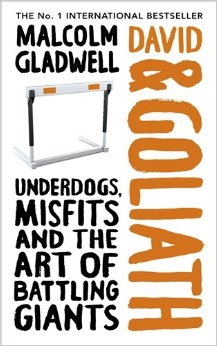
David and Goliath by Malcolm Gladwell - Book Review

Malcolm Gladwell has developed a proven formula for writing international bestsellers: once again, he gives us a book which provides yet more insights into modern society through sharing the fruits of academic research and anecdotes from sociological and psychological study.
At the heart of Gladwell's argument in David and Goliath is a view that power has its limitations. The 'Goliaths' of this world can dominate when the fight is on their terms; how ever if the 'Davids' go about engaging battle in an unconventional way, then there is no reason why the odds should not be in favour of the seeming underdog. Throughout the book, Gladwell works out this thesis in two distinct ways:
  1. First, Gladwell introduces the reader to the concept of the 'Inverted U'. Economists are familiar with this phenomenon: as organisations grow larger, then they benefit from 'economies of scale' (they have increased efficiency, specialisation of job roles and purchasing power); however if an organisation gets too big then 'diseconomies of scale' kick in (the organisation is too big to manage, there are problems of shared vision or internal communication. Gladwell applies this argument to Governments or to large Corporate organisations and demonstrates that unconventional people and approaches can have a greater impact in these circumstances.
  2. Secondly, he argues that apparent natural disadvantages (disability, being an outsider, being unconventional) can often become strengths. It is often the unconventional outsider, who has nothing to lose, who is the true agent of change and progress. This is perhaps best summed up by George Bernard Shaw's observation:
"The reasonable man adapts himself to the world: the unreasonable one persists in trying to adapt the world to himself. Therefore progress depends on the unreasonable man."
Gladwell characteristically focuses on a few key case studies to illustrate his thesis: 
  • the basketball coach who achieved great success with his relatively inexperienced and unskilled team by defying convention by playing full-court press for the whole of the game;
  • the phenomenon that having too much wealth can make parenting even more difficult than the norm;
  • the phenomenon that less academically able students who are top at lesser universities do better than their theoretical betters who are in the bottom stream at top Ivy League schools;
  • that the Impressionists changed the world's perception of modern art by defying convention and striking out on their own setting up a rival to the Salon exhibition;
  • that a disproportionate number of dyslexics make it to the top in commerce by developing other important skills sets to compensate for their problems with literacy;
  • the consultant on the children's Leukemia ward, who because of the hardships that he had faced growing up, thought little of putting his young patients through pain in order to find a cure for their condition;
  • the reasons why the British Army failed to control the Roman Catholic population in Northern Ireland; and
  • how Martin Luther-King succeeded in winning over the Nation to his cause through manipulating the Press.
Gladwell is a supreme story-teller who is able to carry the reader with him through his sheer narrative ability. Nowhere is this more evident than in the opening chapter where he takes the biblical story of David and Goliath and, at the end of his narrative, leaves the reader in no doubt that the odds were stacked to such an extent in Shepherd-boy's favour that the Philistine Champion literally didn't have a chance. However, if we take the book as a whole, Malcolm Gladwell's David and Goliath has only a superficial coherence and it is disappointing that he doesn't really explore his central theme of the limitations of power in anything other than an anecdotal way. Then again, perhaps a balanced argument sits outside the "Gladwell-genre". It remains, nevertheless, a most enjoyable romp - and one not to be missed.